A Discipline of Accountability and Attention
To start with, we're going to build a nuclear power plant...... no I'm just kidding, we might start somewhere simpler, with a bike shed.
To build a bike shed, we need to establish the likely number of people who will use it, the materials required, the location it has to go and then project manage it's construction. Whereas to build a nuclear power plant, well you can see the difference in the tasks.
To wrap some context around this for you though, bike sheds are a reference to Parkinson’s Law of Triviality (Parkinson, 1957). A theory that (people inside ) organisations give disproportionate weight to trivial things. In Parkinson's explanation of his law, a (fictional) committee is responsible for approving and building a nuclear power plant, but during the process will spend most of its time debating the construction of the bicycle shed. The big problem being their primary responsibility is too complex so as a unit they move to tackle the small task, it's achievable, it's almost effortless in comparison and it is easy to present the performance of performing a task, rather than performing the actual task. It demonstrates action and the fictional committee can hide behind the professional excuse of 'working' on part of the task.
Where this shows elsewhere is entirely situational, but the example holds as a demonstration of people taking the path of least resistance. There is far less resistance in a complicated problem (the bike shed) than there is in the complex problem (the nuclear power plant).
Complex problems are complicated but not in the same way a complicated problem is not complex, but the two are connected.
Solving a complicated problem is about working out how to get from A to B when the solution does not yet have a decision made to get there. Whereas a complex problem first requires understanding the moving parts — what they are, how they connect, what to do about them, who is responsible, what completion looks like and when is it done.
The trap with triviality is not the triviality itself. It is the habit of choosing complicated problems while leaving complex ones unowned. Complexity in and of itself is the more difficult and hence why people will choose the path of least resistance as a way to demonstrate progress as it is often favoured over slow tedious and meticulous work involved necessary to solve complex matters.
How come this happens?
I’ve chosen to use two simple ideas to help me explain: light switches and spotlights. When these two get confused, organisations leak time, delay work, and amongst personnel there is a quiet frustration that builds as a compounding interest of costs.
The Light Switch Problem:
No Execution Without Defined Ownership
A light switch can be any task that:
Requires no authority to complete
Has low risk, high frequency and some impact
It exists as obvious work in front of you
Examples are everywhere:
Categorically - turning off a light in an empty room. Anyone can do it.
It might be sending a completed proposal
Refilling paper in the copy machine or locking the doors at night
Following policy and procedure per company instructions on correspondence
These are not decisions that require leadership or discussion. They are habitual acts to achieve workflow completion. They are often governed by implied expectations: accepted societal rules, workplace behavioural norms and unwritten agreements .
Yet most workplaces stall on this. Why?
When tasks aren’t assigned to specific roles by leaders, they can vanish under the guise of 'professional courtesy.' To look busy, workers often mistake 'Light Switches' for tasks that require directive and should be reserved for the attention necessary to focus 'Spotlights' they begin embedding these minor actions into job descriptions instead of allowing them to be owned by whoever is closest to the problem. This creates an unhealthy foundation of bureaucratic drag and wastage, where people protect themselves with process rather than owning the outcome.
More commonly the habitual task isn't execution the execution of the 'Light Switch', it's deferring the responsibility to another.
Instead of the person who noticed the work closing it out, they'll wait for someone else to own it and the light will stay on while the organisation foots the bill, not the individual. (Personal note: As a Dad, this is particularly poignant and I feel as though I have subject matter expertise in Light Switches - I'm always turning these damned things off!)
Within the organisation, this can be buffered for a time, until the point at which the organisational bloat and deferral begins to work against the profitability and the wastage starts impacting the P&L - not just the power bill. Deferrals like these search for someone to formally own a task. But a task like this needs no owner. It just needs to be done.
The light stays on and the cost accumulates.
Time to completion expands & project costs blow out
Client uncertainty increases & trust dissipates
Reputational erosion occurs & repeat business ceases
Energy is wasted in discussion rather than action & we're all ‘crippled by committees’
This is truly a demonstration now of authority deferral at its lowest level - these Light Switches are not strategic, leadership is not necessary, just habitual and it doesn’t happen because people are incapable of doing them. They’re just deferring and this creates cost.

The Cost of Waiting
When tasks take time, costs compound during delay:
Speed collapses — OODA loops stall at “Decide” without “Act”
Ownership diffuses — everyone sees it, no one actions it
Leaders get dragged down — forced to manage trivialities
Culture degrades — initiative becomes optional
What looks like “structure” is often just permission-seeking or task delegation disguised as professionalism.
*OODA Loop: (Observe, Orient, Decide, Act) is a four-step, iterative decision-making framework designed to outpace opponents by rapidly cycling through information gathering, analysis, decision, and implementation to gain a competitive advantage
The Light Switch Rule: “Fully Focused, Always Owned”
A fully functioning organisation can run on a simple principle of efficiency:
If you see it, and it requires no authority, do it.
This is principle is about removing friction where none should exist. Because in order for an organisation to continually progress without micro-management, execution of habitual tasks should be ambient and always happening keeping the things always moving.
The Spotlight Problem (Attention Without Discipline)
Now flip the problem.

Where light switches suffer from too much deferral, spotlights suffer from too little constraint. To define the difference, a spotlight must possess a unique impact across the organisation and require:
Strategic direction
Resource allocation
Market focus
Priority setting
In theory, a company can do anything:
Enter new markets
Launch new services
Shift operating models
In practice, a company exists in a chosen niche - it is the reason they exist. Without a clear position, no customer will know what that company does and neither will they be able to understand the reason behind why they would engage the services of said company.
The Company Value Razor forms a core operational philosophy, mandating that 'every employee’s activity must exclusively create demonstrable and positive value for the organisation.' This non-negotiable standard acts as a continuous filter for all tasks and resource allocations.
When an employee’s time or output does not measurably contribute to the company’s progress, profitability, efficiency, or strategic goals, the necessity of that activity must be rigorously addressed.
Considering that an employee’s salary is a liability on the P&L statement, a critical discrepancy arises when the value generated by said employee fails to demonstrably exceed the cost of compensation and overheads. Adherence to the Company Value Razor ensures payroll is an investment yielding a significant return, not a draining expenditure, thereby guaranteeing fundamental organisational viability.
The Role of Authority & Focus
Unlike light switches, spotlights as tasks require:
Clearly defined ownership
Absolute or approved (delegated) decision rights
Intentional constraint as to role responsibilities
Explicit boundaries for accountability
Without these requirements enacted, the two most important resources (within the workforce) are wasted - time and attention as limited resources which cannot be inventoried and without structure are lost.
Ipso factor, if everyone has control over the spotlight or it's not clearly focused:
Strategy fragments - attention is spread thin
Teams pull in different directions - inventory’s lost (Time)
Resources dilute - leakage occurs with lost productivity
Execution loses coherence - Parkinson’s other law, the one about work ever expanding to fill the gaps is unnecessarily invited into your workplace.
The result is noise. Signal disappears. The commitment to creating value exclusively breaks down.
The Spotlight Rule: “Defined Authority Sets Direction”
Only those with defined authority need set direction, everyone else is responsible for executing it.
This is where authority calibration matters, no confusion. no overlap. Just work:
Leaders MUST define where the spotlight points
Teams operate within that spotlight
Individuals execute without waiting on trivialities
Where Organisations Break
Most workplaces invert the model:
Leaders MUST define where the spotlight points
Teams operate within that spotlight
Individuals execute without waiting on trivialities
Where Organisations Break
Most workplaces invert the model:
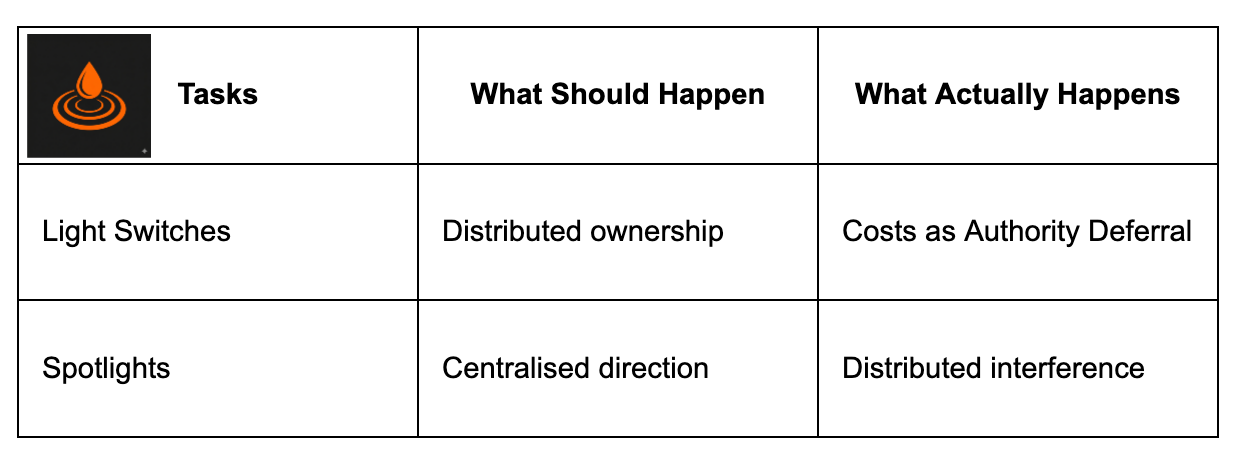 So you get:
People waiting to act on obvious tasks
People interfering in decisions they don’t own
Both of which create an inefficient leakage loop causing losses across the organisation and a devaluation as the Company Value Razor loses out to the Law of Triviality and focus turns from nuclear reactors to bike sheds.
Accountability as a function of attention
Accountability is not a personal virtue. It is a structural outcome — shaped by where the system allows attention to settle.
When leaders spend their attention on trivial tasks, ambiguity ensues and clarity turns to chaos.
When focus drifts across strategy without clear direction, teams become lost.
The fix is simple, but not easy:
1. Liberate execution
Make light switches everyone’s responsibility. Clarify not just roles and responsibilities, but the authority that lets decisions be made without fear.
2. Constrain direction
Make it clear what a spotlight is, who owns it, when it is done and how that looks.
3. Remove the middle noise
Kill bureaucracy dead
2 Step Standard
A disciplined organisation runs well when:
Light Switches are turned on or off by those in proximity because trust and delegation exists.
Spotlights are focused deliberately because accountability and ownership are assigned.
Then the Company Value Razor becomes the rule, not the exception.
Knowing what your light switches are enables the actions of habit without deferral creeping in the back door of your company culture and controlling the spotlights creates clarity.
Together, they provide the conditions for a fully focused organisation.
Note on evidentiary status
Theoretical, proposed, and falsifiable — not empirically validated: the Light Switch / Spotlight distinction as a category of organisational task, the claim that authority deferral operates at this granularity, and the Company Value Razor as a governing operational principle. These are presented as a diagnostic lens developed through Sovereign Leadership, not as tested findings. Parkinson's Law of Triviality (Parkinson, 1957) is an independently sourced, established concept, applied here as illustration rather than as evidence for Sovereign Leadership's own claims.
References
Parkinson, C. N. (1957). Parkinson's law, or the pursuit of progress. John Murray.